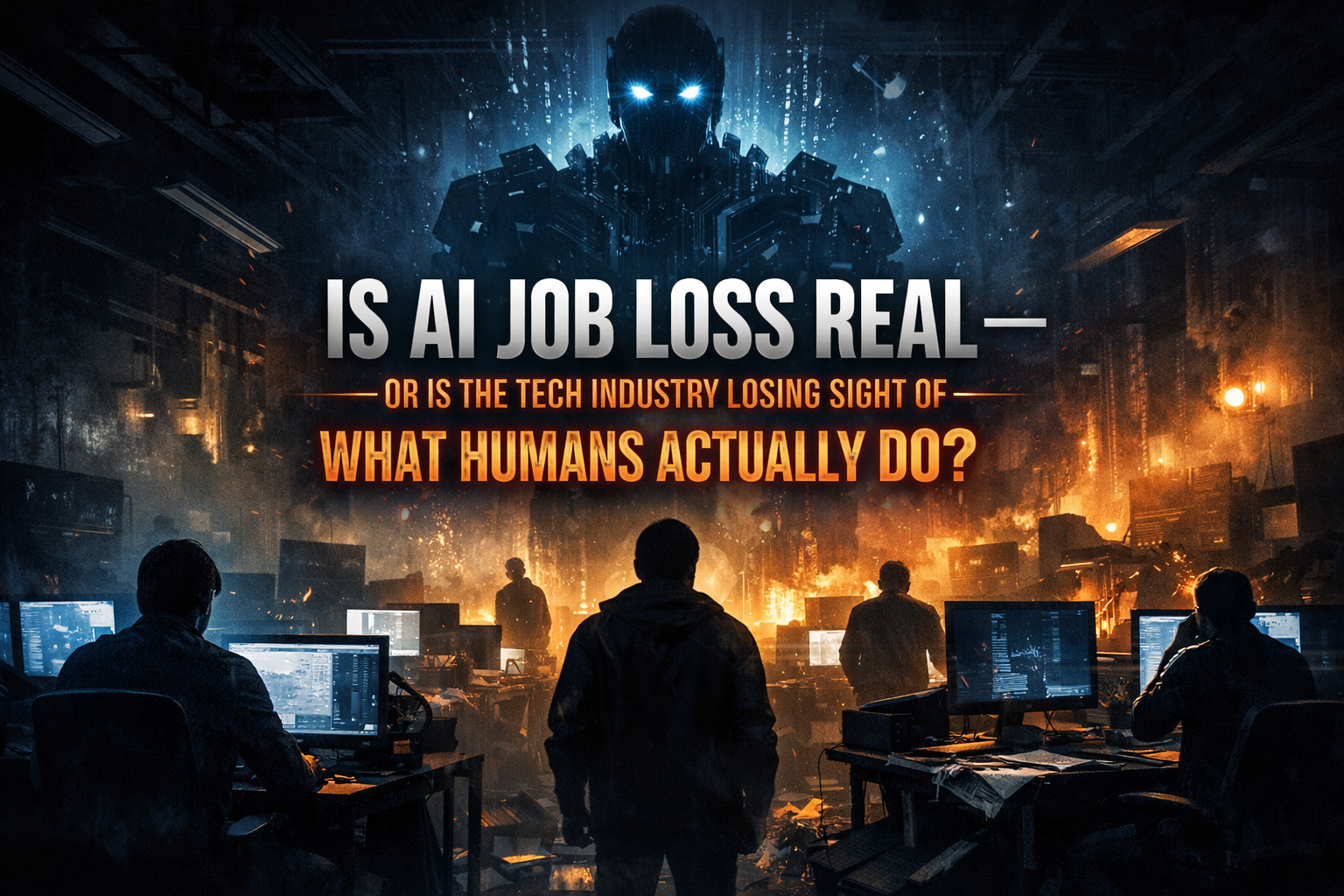
Why “AI Will Cause Layoffs” Isn’t a Theory — It’s Already Being Used to Justify Decisions
Why “AI Will Cause Layoffs” Isn’t a Theory — It’s Already Being Used to Justify Decisions
“AI can’t do most of our work — yet we’re getting laid off anyway.” — a sentiment echoed across developer forums and tech layoffs discussions.
If you’ve been reading industry discourse, you’ve likely seen:
- “AI will replace jobs”
- “AI adoption will lead to massive layoffs”
- “Engineers are afraid of automation”
But a closer look at actual layoffs shows something subtler — and more structural — than a simple fear of replacement.
The reality isn’t that AI is suddenly capable of doing every job.
The reality is that AI is already being used as justification for workforce decisions — even when the technical case for replacement is weak.
AI as a Rationale — Not a Capability
On paper, AI systems are still far from capable of replacing nuanced developer roles. Yet companies are restructuring teams and reducing headcount in the name of AI.
This isn’t just hype. It’s a shift in decision logic.
Executives often frame labor decisions like this:
“Introducing AI tech lets us reorganize teams for higher efficiency.”
That language is important. It doesn’t explicitly say:
“AI replaces humans.”
Instead it shifts the narrative to:
“AI enables us to restructure labor.”
The change is subtle on the surface but powerful in practice.
Real Worker Voices: Layoffs + AI Adoption
Developers observing layoffs aren’t saying:
“AI is perfect now.”
They’re saying:
“Management used AI as the reason to reduce staff.”
People in tech communities share posts like:
- “I got laid off because ‘AI will handle this now’.”
- “We had plenty of backlog, but they said AI makes the role unnecessary.”
- “It wasn’t about performance — it was about ‘AI strategy’.”
These sentiments reveal a dynamic where AI becomes a convenient narrative for cost decisions, not a literal replacement.
That’s a management pattern — not a technological inevitability.
Why Companies Use AI as Justification
Businesses operate with two priorities:
- reduce uncertainty
- control costs
If AI tools claim to:
- improve throughput
- reduce cycle time
- offer automation
…then leadership is tempted to act on the promise of those improvements — often faster than is technically justified.
From a corporate standpoint, the reasoning looks like:
AI signals productivity gain
→ leadership reduces variable costs
→ labor is cut
Notice what’s missing?
There’s no explicit governance or accountability in that decision. It becomes a rationalization instead of a verification of value.
What This Means for Developers
Layoffs framed as “AI-related” create a real sense of insecurity — and developers aren’t wrong to be concerned.
But the fear isn’t about AI doing the work.
The fear is about:
- how decisions are being made
- who owns those decisions
- what gets measured
- how justification is constructed
When decisions are based on ambiguous signals instead of structured, verifiable authority, the outcomes can be unpredictable and painful.
This isn’t “AI replacing jobs” — it’s organizations using AI as a narrative lever in decisions that were always about cost.
That’s a different problem — and it points back to your real leverage: decision design systems.
Decision Ownership Is What Matters
If layoffs are justified by vague productivity language rather than measurable outcomes, you end up with:
- inconsistent criteria
- subjective interpretations
- no audit trail
- no accountability
That’s how AI becomes a scapegoat.
Under a Decision Boundary Framework (DBF):
- AI signals must be verified
- decisions must be deterministic and traceable
- authority must be explicit
- outcomes must be auditable
Without these boundaries, leadership will always lean on the easiest narrative — and workers bear the consequences.
How Developers Can Stay Indispensable
If AI isn’t literally replacing work, then what is it replacing?
It’s replacing:
- negotiated labor cost
- implicit judgment
- unstructured decision authority
But it cannot replace:
- human accountability
- systems thinking
- context-aware decision logic
- domain-specific judgment
Those skills are rare and valuable — because they involve authority and accountability, not just execution.
Designing systems that expose where decisions are made and who owns them is what keeps human judgment central.
And that’s exactly what AI Under Pressure is built to teach.
Closing: Real Change Is Not a Tool Problem — It’s a Decision Problem
If layoffs are being justified with AI language — even when AI isn’t technically capable of full replacement — we’re not dealing with a technology problem.
We’re dealing with a decision governance problem.
That’s why developers who understand systems — not just tools — will be the ones who stay valuable.
Call to Action
If you’ve seen AI referenced in staffing decisions — not because of capability but because of justification — you’re seeing the consequence of undefined decision authority.
To build systems where human judgment isn’t sidelined, join the early adopter list for AI Under Pressure — the course that teaches how to design and govern AI systems responsibly.
Launching January 30, 2026.
Ready to Build This System?
Join the Early Adopter cohort and get access to live training, direct feedback, and influence on course refinement.
Early Adopter Cohort — Limited Access
Regular Price
$499
Early Adopter Price
$299
Save $200 — 40% off
This is a limited early cohort. Early adopters get access to the course while it is still being refined.
Early adopters get:
- Live, instructor-led training sessions
- Direct feedback on your system
- Influence on course refinement
Once the system stabilizes, live sessions will be recorded and future students will receive on-demand access only.
Early adopters get proximity.
Later students get the library.